

February 2, 2026
Dear Policymaker/Employer/Leader,
We are the Women RISE Leaders at Bangladeshi Canadian Community Services (BCS)—a youth led group of racialized and immigrant women building leadership, advocacy skills, and economic participation across Toronto. Through workshops, mentoring, and community mobilization, we represent a growing network of young women taking action on the issues that directly shape our lives. The Women RISE project is supported by Women and Gender Equality Canada.
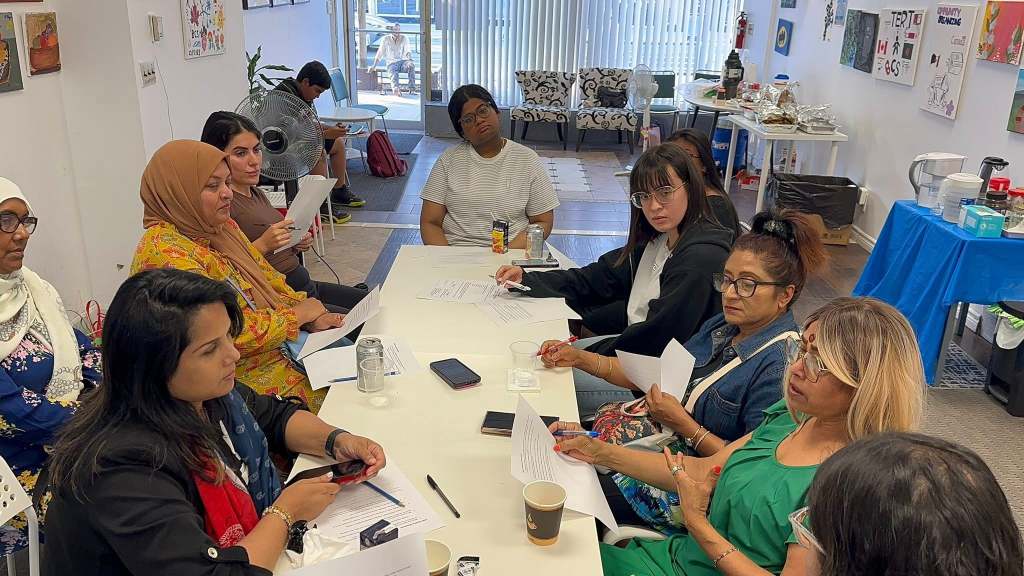
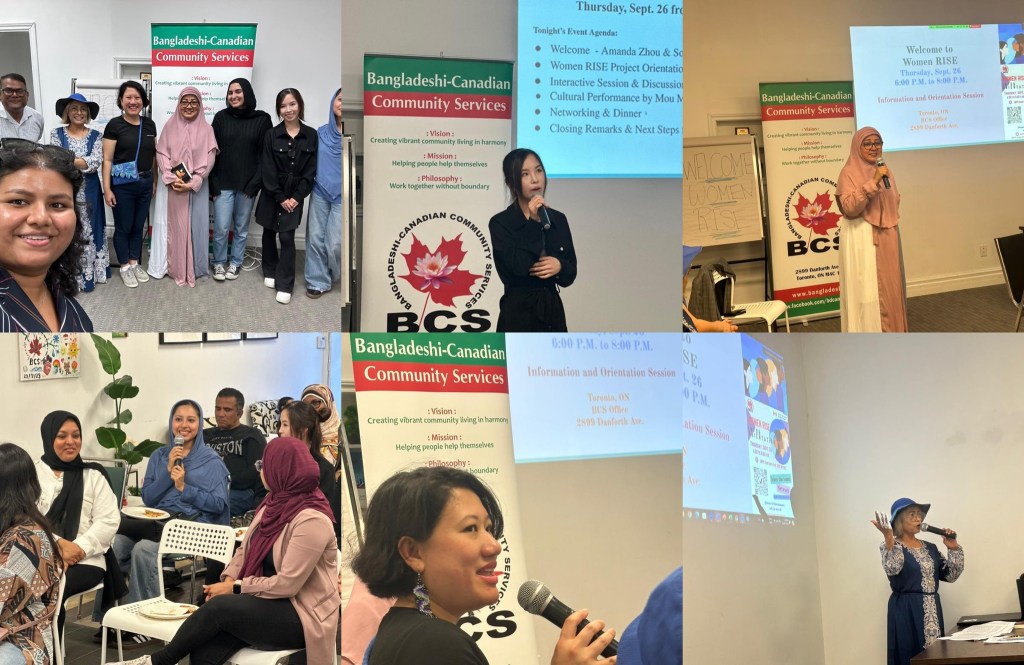
Caption: Women RISE Feminist Leaders amplifying the voices of racialized and immigrant women through Focus Group Discussions.
In 2025, we partnered with BCS to design and conduct a Community-Based Research (CBR) to understand the economic realities of racialized and immigrant women. A total of 255 racialized women and girls participated in surveys, 20 participated in focus groups, and others took part in art-based activities across the Greater Toronto Area. These findings reflect lived knowledge— not only statistics—and point to an urgent need for policy and practice interventions.
1. Ensure Equitable Access to Employment and Economic Opportunities for Racialized and Immigrant Women
Research shows that while skills and education are strong, opportunities remain limited. Women reported being asked, “Do you have Canadian experience?” and “I know four languages… they don’t give credit for bilingual skills.” Findings indicate that key barriers include: 57% reporting lack of Canadian work experience, 66% limited access to networks or mentors, 30% difficulties with credential recognition, and 62% limited awareness of available job opportunities.
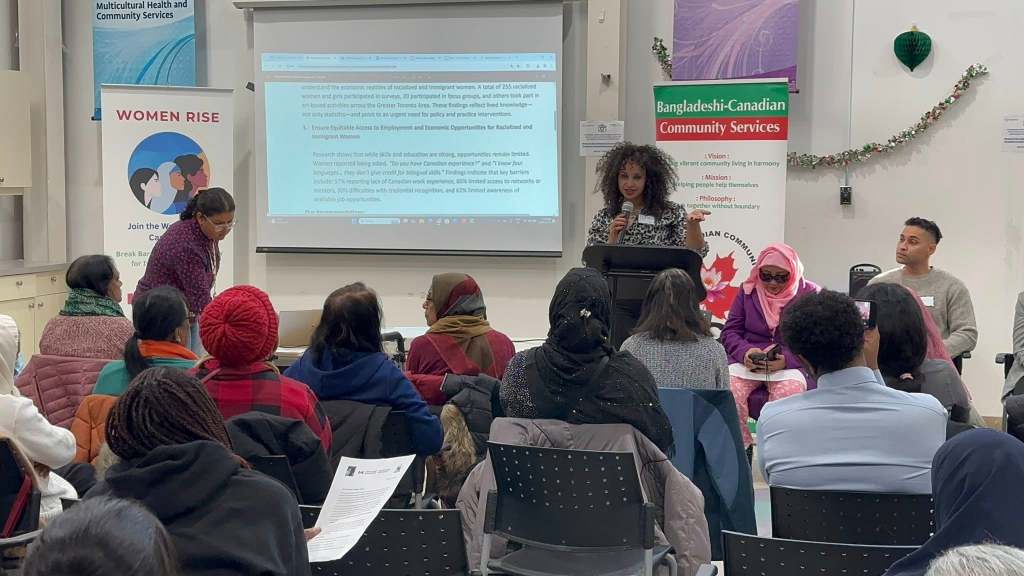
Caption: Women leaders presenting community-based research findings and mobilizing community support for women’s social and economic prosperity in Toronto.
Our Recommendations:
I. Implement inclusive hiring practices to remove “Canadian experience” barriers. II. Standardize recognition of international credentials.
III. Create mentorship placements for racialized women.
IV. Launch targeted grants, microloans, and training programs
V. Expand access to bridging, STEM, trades, digital literacy, and financial literacy programs
2. End Workplace Discrimination and Advance Economic Prosperity for Racialized Women
Persistent discrimination was reported tied to names, gender, accents, religion, and newcomer identity. Participants shared: “Underhanded racism… because you’re not Canadian” and “I contemplated changing my name on my résumé.” Findings show 92.5% experienced racial discrimination, 41% reported gender-based discrimination, 42% stated gender affected economic independence, and 50% do not earn a living wage. Microaggressions, token hiring, and bias against ethnic dress or headscarves are common.
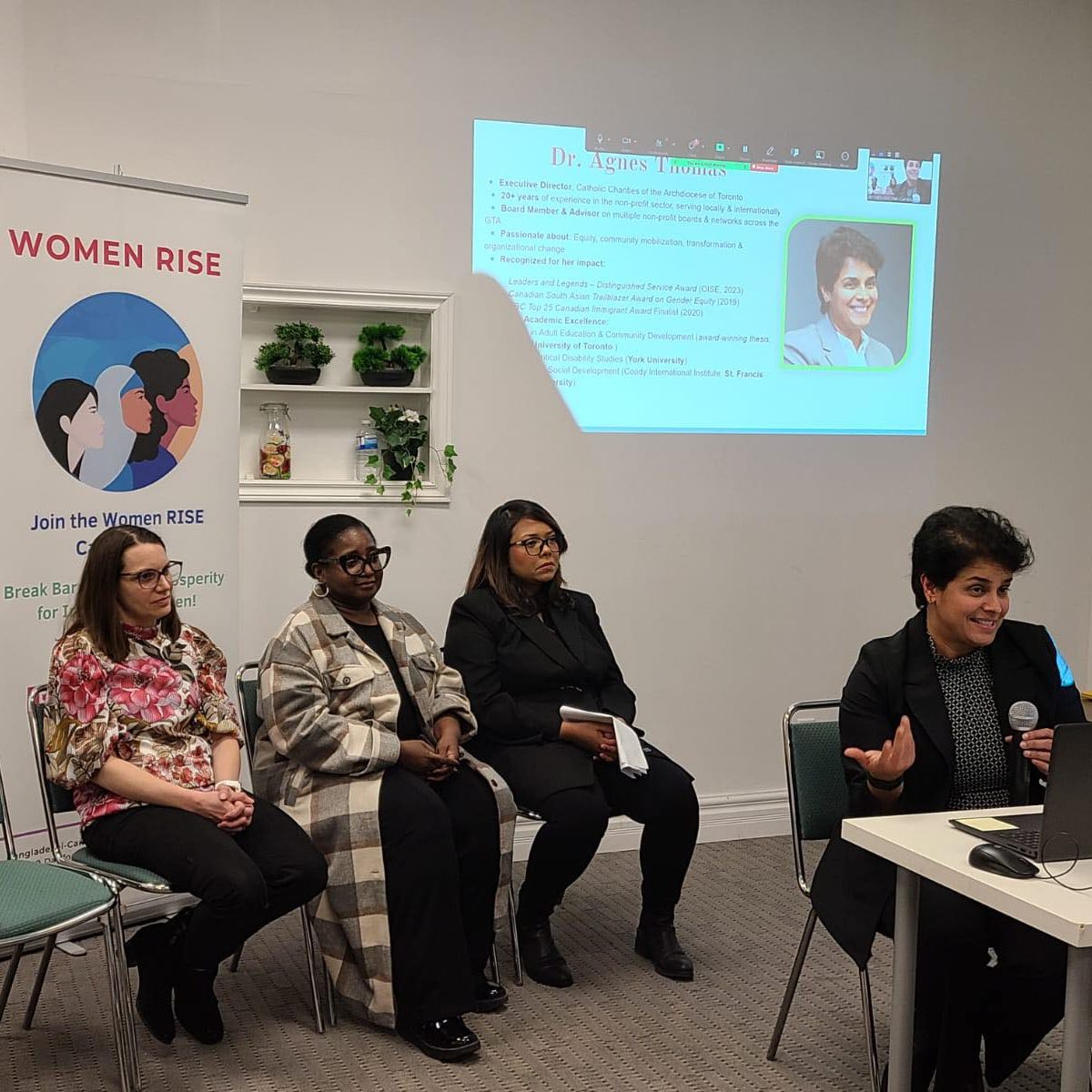
Caption: Mentors from diverse sectors coming together to support Women to RISE.
Our Recommendations:
I. Implement anti-discrimination and anti-racism policies in all workplaces
II. Ensure 10%-15% representation of racialized women in leadership roles
III. Conduct pay equity audits and enforce transparency
IV. Introduce blind hiring and mandatory diversity training
V. Collect race- and gender disaggregated employment data annually to guide policy.
Moving Forward
Your leadership in labour markets and communities is critical. We urge you to:
Immediate Action: What steps is your office taking to improve economic opportunities for racialized and immigrant women?
Collaboration & Accountability: How will you work with us to translate these recommendations into measurable outcomes?
We are ready to collaborate to advance the economic prosperity of racialized women and girls in Toronto and across Canada.
Sincerely,
Women RISE Leaders
Bangladeshi Canadian Community Services (BCS)
womenrisebcs@gmail.com | info@bangladeshi.ca
womenrise.ca | bangladeshi.ca
2899 Danforth Avenue, Toronto, ON M4C1M3 | Tel. 416-699-4484
Letter Campaign Update:
To ensure that these findings reached decision-makers and stakeholders, Women RISE Feminist Leaders launched a large-scale Letter Campaign in February 2026. Through a combination of email and mailed letters, the key findings and recommendations from the CBR were shared with 100 leaders and organizations across multiple sectors. Recipients included 26 elected officials across the GTA, including the Ontario Premier, Mayors, City Councillors, Members of Parliament (MPs), and Members of Provincial Parliament (MPPs); 9 heads of federal government departments; 4 municipal departments; 29 business regulatory bodies and corporations; 6 post-secondary institutions; 19 non-profit organizations and community partners; and 7 local and national media outlets. The campaign called for inclusive hiring practices, recognition of international credentials, expanded mentorship opportunities, anti-racism measures, pay equity, and increased representation of racialized women in leadership positions.
The findings were further disseminated through three Community Dialogue Sessions attended by more than 260 participants, including community members, employers, partners, researchers, service providers, and policymakers. These dialogues created opportunities for direct engagement between Women RISE Feminist Leaders and decision-makers. Feminist Leaders and researchers presented their findings and recommendations during dialogues with MPP Doly Begum, MPP Michelle Cooper, and MPP Kristyn Wong-Tam, fostering meaningful conversations about employment equity, economic security, and systemic barriers facing racialized immigrant women. Community partners including United Way, the City of Toronto, CASSA, and West Scarborough Neighbourhood Community Centre participated in the discussions, contributing their perspectives and exploring opportunities for collaboration and collective action.
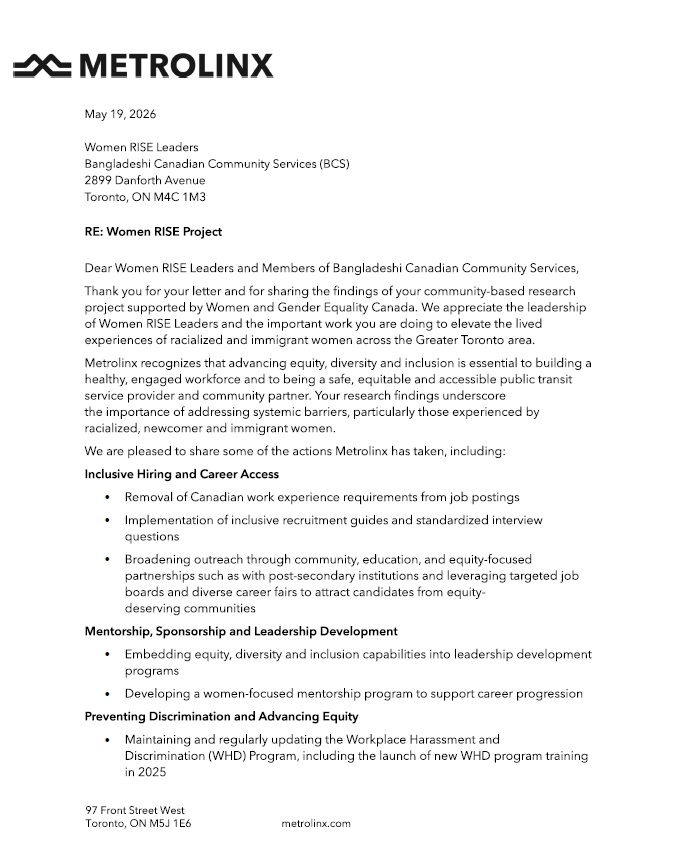
METROLINX Response to the Women RISE Letter Campaign
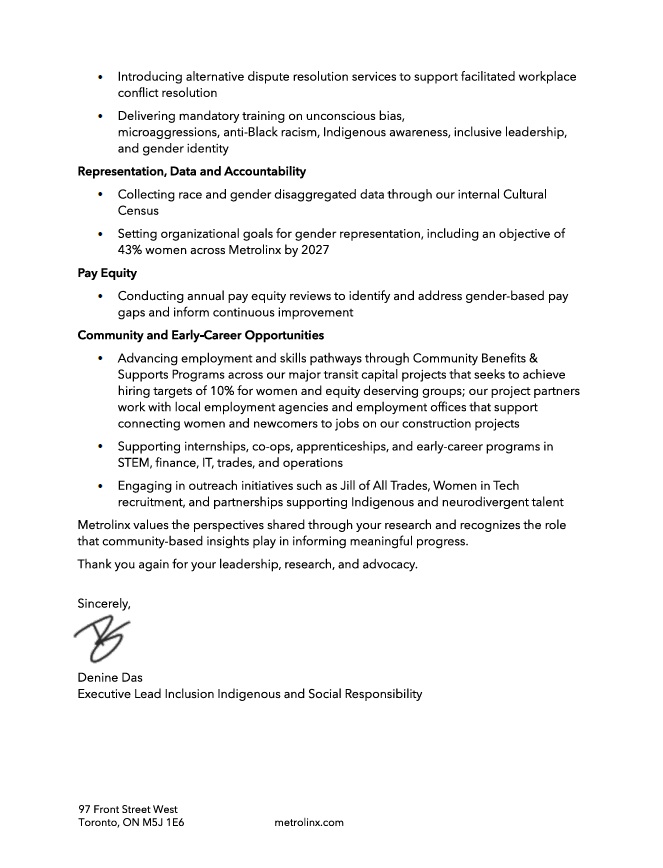
A significant outcome of the Women RISE Community-Based Research and Letter Campaign was the formal response received from Metrolinx, one of Ontario’s largest public agencies and employers. In its letter to Women RISE Leaders, Metrolinx acknowledged the value of the community-based research and recognized the importance of addressing systemic barriers faced by racialized, newcomer, and immigrant women. The organization highlighted several existing and planned equity initiatives that align closely with the recommendations presented in the Women RISE report, including removing Canadian work experience requirements from job postings, implementing inclusive recruitment practices, expanding mentorship and leadership opportunities for women, strengthening anti-discrimination measures, conducting pay equity reviews, collecting race- and gender-disaggregated data, and increasing employment pathways for women and equity-deserving communities. This formal institutional response demonstrates that the Women RISE advocacy efforts successfully reached influential decision-makers and contributed to meaningful dialogue on equity, diversity, inclusion, and workforce development, illustrating the potential of community-led research to influence organizational policies and practices.
Beyond knowledge mobilization, the CBR and Letter Campaign served as powerful leadership and advocacy tools for Women RISE Feminist Leaders. Participants moved beyond documenting barriers to actively engaging policymakers, employers, and community leaders in discussions about solutions. Through research, public presentations, dialogue sessions, and advocacy efforts, they strengthened their leadership, communication, and civic engagement skills while amplifying the voices of racialized and immigrant women.
The Women RISE Community-Based Research and Letter Campaign demonstrate how community-led research can generate evidence, elevate lived experiences, influence public dialogue, strengthen partnerships, and mobilize collective action. By engaging hundreds of community members and stakeholders while reaching decision-makers across government, education, business, media, and community sectors, the initiative contributed to advancing conversations on equity, economic inclusion, and systemic change for racialized and immigrant women.
 Women RISE Toronto Campaign